Table of Contents
What Are the Five Pillars of Islam?
The Five Pillars of Islam (أركان الإسلام — Arkan al-Islam) are the five fundamental acts of worship that form the foundation of Muslim life. The Prophet Muhammad ﷺ said: "Islam is built on five things: the testimony that there is no deity worthy of worship except Allah and that Muhammad is the messenger of Allah; establishing prayer; giving Zakat; Hajj; and fasting in Ramadan." (Bukhari & Muslim)
The image of a building is deliberate. Just as a building without its structural pillars collapses, a Muslim's faith without these five practices lacks its essential framework. The Pillars are not separate from each other — they are interconnected. Salah keeps the heart attached to Allah throughout the day. Fasting teaches the body to submit to the soul. Zakat connects the individual to the community. Hajj connects all Muslims to each other and to the history of their faith.
Pillar 1: Shahada — The Declaration of Faith
Ash-hadu an la ilaha illallah, wa ash-hadu anna Muhammadan rasulullah — "I bear witness that there is no deity worthy of worship except Allah, and I bear witness that Muhammad is the messenger of Allah."
The Shahada is the gateway to Islam. When a person says these words with genuine understanding and conviction, they enter the fold of Islam. But the Shahada is not a one-time declaration — it is a living reality that a Muslim affirms daily through their Salah, their choices, and their worldview.
What does Tawheed (the oneness of Allah) mean in practice? It means that Allah alone is worthy of worship — not prophets, saints, graves, or idols of any kind. It means that Allah's word (the Quran) is the ultimate authority. It means that every decision, relationship, and ambition is ultimately accountable to Allah. Tawheed is not just a theological statement — it is a complete way of seeing the world.
Pillar 2: Salah — The Five Daily Prayers
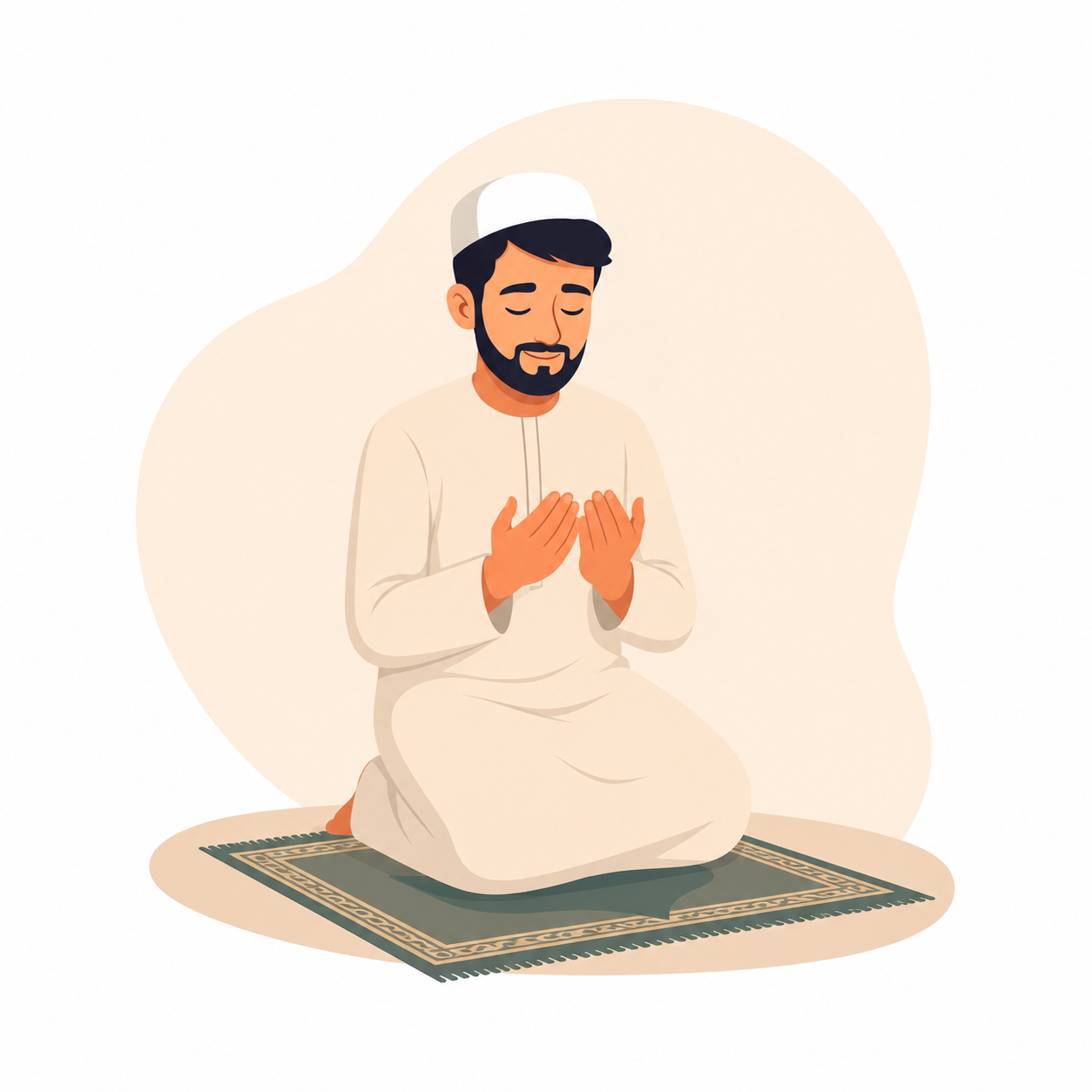
Five prayers every day, from puberty until death: Fajr (2 rak'ahs at dawn), Dhuhr (4 rak'ahs at midday), Asr (4 rak'ahs in the afternoon), Maghrib (3 rak'ahs at sunset), Isha (4 rak'ahs at night). Total: 17 rak'ahs daily.
Salah was not given to the Prophet ﷺ through an angel on earth — it was the gift of the miraculous night journey (Isra' wal Mi'raj), when Allah called the Prophet ﷺ directly to Himself. Originally fifty prayers, reduced to five through the Prophet's ﷺ repeated intercession for the ummah — yet carrying the reward of fifty. This context matters: Salah is not a religious duty in the ordinary sense. It is an audience with Allah, five times a day, for the rest of your life.
Pillar 3: Zakat — Obligatory Charity
Zakat is the annual compulsory giving of 2.5% of accumulated wealth (above the Nisab threshold — approximately £500 in gold or £350 in silver value, checked annually) to specific categories of recipients defined in the Quran.
Zakat is not voluntary charity — it is a right that belongs to the poor within the wealth of the rich. Allah says: "And those in whose wealth there is a known right, for the one who asks and for the deprived." (Quran 70:24–25). Zakat purifies wealth — the word itself means "purification" — and redistributes resources within the Muslim community, preventing the extreme concentration of wealth.
Who must pay Zakat? Any Muslim who has been in possession of wealth above the Nisab threshold for a complete lunar year. Zakat is due on gold, silver, cash, business goods, and agricultural produce (at different rates). It is not due on personal belongings, a primary residence, or a vehicle used for personal use.
Pillar 4: Sawm — Fasting in Ramadan
Fasting the entire month of Ramadan — from the pre-dawn meal (Suhoor) until sunset (Iftar) — is obligatory for every adult Muslim who is healthy and able. This means abstaining from food, drink, smoking, and sexual relations from Fajr to Maghrib for 29 or 30 consecutive days.
The wisdom of Sawm is profound and multi-layered. Physically, it is a complete submission of the body's most powerful desires — hunger and thirst — to the command of Allah. Spiritually, it is a month-long retreat into increased worship, Quran recitation, and proximity to Allah. Socially, it builds empathy — the Muslim who fasts knows, even briefly, what it feels like to be hungry. This is why Ramadan is also the month of the greatest Sadaqah (voluntary charity).
Pillar 5: Hajj — The Pilgrimage to Makkah
Once in a lifetime, for those who are physically and financially able, every Muslim must make the pilgrimage to Makkah during the month of Dhul Hijjah. Hajj is the most extraordinary gathering of human beings on earth — millions of Muslims of every race, nation, language, and background, united by white Ihram and a single call: Labbayk Allahumma labbayk — "Here I am, O Allah."
Hajj enacts the story of Ibrahim, Hajar, and Ismail alayhimus-salaam — a family's total submission to Allah's will. It is a rehearsal for the Day of Judgement, when all of humanity will stand before Allah, stripped of rank and status. The Prophet ﷺ said: "An accepted Hajj has no reward other than Paradise." (Bukhari)
Teaching the Five Pillars to Your Children
The Five Pillars should not be taught as a list to memorise — they should be lived experiences that children encounter naturally within the family. Here is how each pillar can be introduced at home:
- Shahada — teach it as the most beautiful sentence in the universe. Ask: "What does it mean that Allah is One? What does it mean that Muhammad ﷺ is His messenger?"
- Salah — pray in front of your children from infancy. Invite them to join. Make prayer time special.
- Zakat — involve children in Zakat calculation and giving. "This is the money we give because it belongs to people who need it more than us." Many families give children a portion to donate themselves.
- Sawm — make Ramadan the most special month of the year. The child who associates Ramadan with family, spirituality, and celebration will love it for life.
- Hajj — the Day of Arafat (9th Dhul Hijjah) is a day of fasting and du'a even for those not at Hajj. Fast this day together and make du'a as a family — this gives children a real experience of the Hajj season.
Frequently Asked Questions
The Five Pillars are the foundational acts of worship explicitly named in the hadith of Jibreel as "Islam." Other acts — such as Jihad (which in its broadest meaning is any struggle for Allah's sake), giving Sadaqah, or spreading knowledge — are important obligations and Sunnah practices but are not part of the Five Pillars specifically. Iman (faith) has its own Six Pillars (belief in Allah, angels, books, messengers, the Last Day, and divine decree) — these are distinct from the pillars of Islam.
The scholars have different views on the one who abandons Salah specifically. The majority consider abandoning Salah entirely, while believing in its obligation, to be a major sin of the highest order. Missing Salah through laziness must be made up; denying its obligation is a matter of creed. For other pillars, deliberate and permanent abandonment without excuse is a major sin. But Islam always opens the door of Tawbah — return to Allah is always possible.
At Moddaker Academy, the Five Pillars are a core part of our Islamic Studies curriculum for children. We teach each pillar with its evidence from Quran and Sunnah, its practical application, and its wisdom — not just as information to memorise, but as acts of worship to understand and love. Sessions are in English, one-on-one, and designed to answer children's real questions about their faith.

Start Your Quran Journey with a Free Trial Lesson
Join hundreds of Muslim families across the UK learning with certified Al-Azhar scholars — one-on-one, online, at your pace.