Table of Contents
What Is Tajweed?
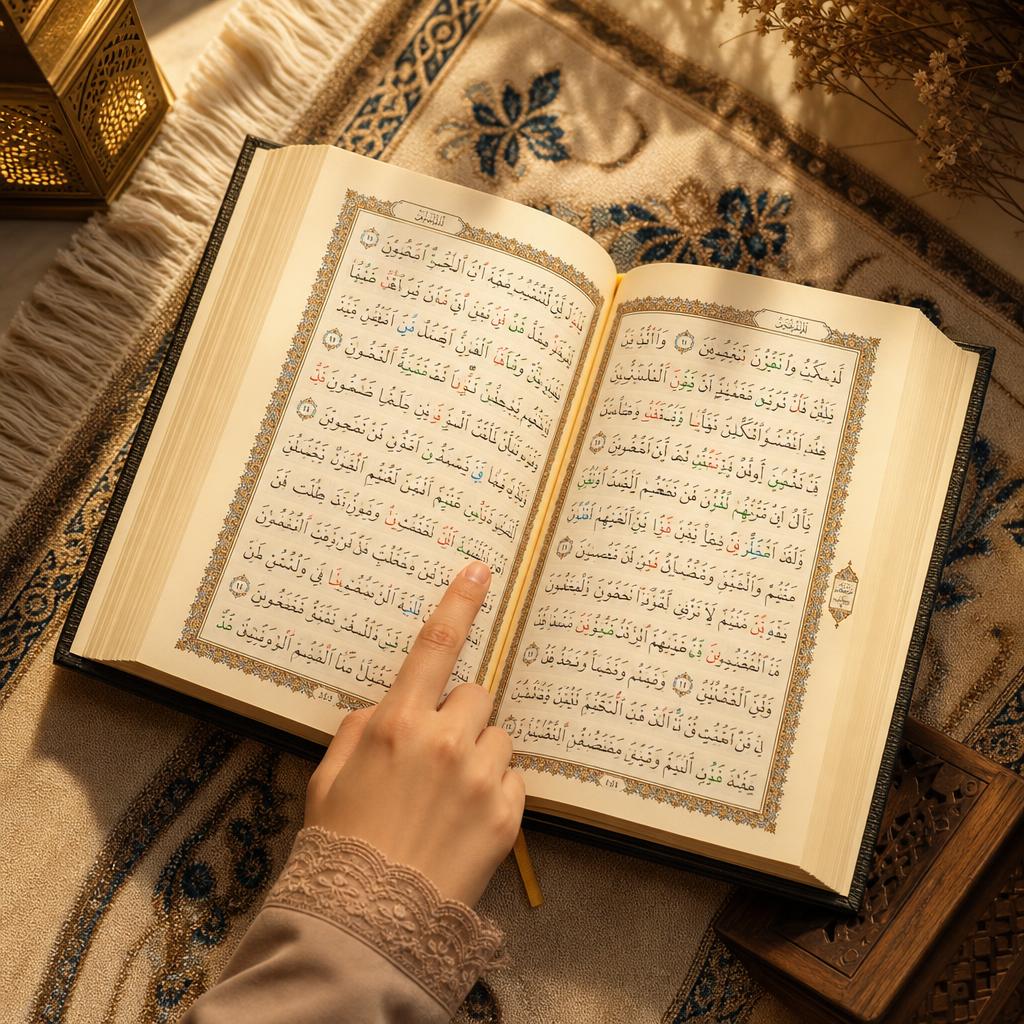
Tajweed (تجويد) literally means "to make better" or "to improve." In Quranic recitation, it refers to the set of rules governing how each letter, vowel, and word of the Holy Quran should be pronounced. These rules were not invented by scholars — they are the precise way in which the Quran was revealed to the Prophet Muhammad ﷺ and transmitted through an unbroken chain of teachers ever since.
When you recite the Quran with Tajweed, you are not simply reading Arabic text. You are honouring the divine words with the same precision and beauty with which they were revealed. A single letter mispronounced can, in some cases, change the meaning of a word entirely — which is why Tajweed is taken so seriously in Islamic scholarship.
"And recite the Quran with measured recitation." — Al-Qur'an, Surah Al-Muzzammil 73:4
Why Is Tajweed Obligatory?
Scholars of the Quran agree that implementing Tajweed correctly is an individual obligation (Fard Ayn) upon every Muslim who recites the Quran. Deliberate disregard for Tajweed is considered sinful. This is not a harsh ruling — it reflects the sanctity of the Quran and the importance of preserving its original form.
That said, scholars make an important distinction: a person who is genuinely trying to learn and apply Tajweed, but makes mistakes due to lack of knowledge, is not blameworthy. The obligation is to make the effort to learn. This is why every Muslim — regardless of age or background — has a responsibility to seek proper Tajweed instruction.
The Main Tajweed Rules Explained
Makhaarij Al-Huroof (Articulation Points)
Every Arabic letter has a precise point of articulation — a specific place in the mouth or throat from which it originates. There are 17 main articulation points. Mastering these is the foundation of all Tajweed.
Sifaat Al-Huroof (Letter Characteristics)
Beyond where a letter comes from, each letter has characteristics — whether it is heavy or light, whether its sound continues or stops, whether it whistles. These properties affect how surrounding letters are pronounced.
Noon Saakinah and Tanween Rules
When a Noon without a vowel (Noon Saakinah) or Tanween appears before certain letters, specific rules apply — Idgham (merging), Iqlab (substitution), Ikhfaa (concealment), or Izhar (clear pronunciation).
Meem Saakinah Rules
Similar to Noon Saakinah, a Meem without a vowel has its own set of rules when it meets certain letters.
Madd (Elongation) Rules
Certain letter combinations require the vowel sound to be elongated — held for 2, 4, or 6 counts. Madd rules are among the most important in Tajweed and among the most commonly violated.
Qalqalah (Echoing Sound)
Five specific letters, when they appear without a vowel, produce a slight echoing or bouncing sound. This is a distinctive feature of Arabic recitation that non-native speakers often overlook.
Why Online Tajweed Lessons Work So Well
Tajweed is fundamentally about listening and being listened to. A good Tajweed teacher hears every pronunciation and corrects it in real time. This is precisely what online one-on-one sessions excel at.
- Immediate correction — The teacher hears your recitation and corrects errors instantly, before bad habits have a chance to form.
- Recording capability — Many platforms allow sessions to be recorded. Students can listen back and identify their own errors.
- Specialised teachers — The best Tajweed scholars are not necessarily local to you. Online removes this barrier.
- Flexible pacing — One-on-one online sessions move at exactly your pace — no rushing because of other students, no waiting for others to catch up.
How Long Does It Take to Learn Tajweed?
Learning Tajweed rules theoretically is the first phase. Applying them fluently while reading the Quran is the second — and longer — phase. Most students can learn the main rules within 3–6 months of consistent study. Applying them smoothly across the entire Quran is a lifelong refinement that even veteran reciters continue working on.
Choosing the Right Tajweed Teacher Online
- They must hold an Ijazah in Tajweed — An Ijazah certifies that the teacher's recitation has been verified by a chain of scholars going back to the Prophet ﷺ.
- They teach Tajweed theoretically AND practically — The best teachers explain the rule, demonstrate it, then have you apply it — not just one of these three.
- They are patient with non-native speakers — Arabic sounds that do not exist in English require significant repetition to master. The teacher should be encouraging, not dismissive.
- Al-Azhar or equivalent qualification — Al-Azhar graduates have formal training in the science of Tajweed as an academic discipline, not just personal practice.
Frequently Asked Questions
Absolutely — in fact, this is the most common situation. Most of our adult students can already read the Quran but want to improve their recitation. Our Tajweed programme is specifically designed for learners who can read but want to apply the rules correctly and beautifully.
Not at all. Children who learn Tajweed from an early age tend to apply it more naturally because they have fewer ingrained habits to correct. We have Tajweed students as young as 7 at Moddaker Academy. For children, we introduce Tajweed concepts gradually alongside their Quran reading.
No. Tajweed is about pronunciation, not understanding the meaning of Arabic. The rules are taught in English (or your preferred language) and applied to the Arabic text. You do not need to speak or understand conversational Arabic.
In a typical Moddaker Tajweed session: the tutor explains a rule, demonstrates it, then listens to you apply it in your reading. Corrections are made in real time. The tutor may replay their demonstration, slow down specific sounds, or use a shared Quran screen to highlight the relevant letters. It is highly interactive.
Tajweed refers to the rules of pronunciation. Tarteel refers to the measured, unhurried pace of recitation — the mode in which the Quran was revealed. The Quran instructs Muslims to recite it with Tarteel (73:4). Applying Tajweed correctly while maintaining Tarteel is the ideal form of Quranic recitation.

Start Your Quran Journey with a Free Trial Lesson
Join hundreds of Muslim families across the UK learning with certified Al-Azhar scholars — one-on-one, online, at your pace.