Table of Contents
What Is Hajj?
Hajj is the fifth and final pillar of Islam — the pilgrimage to the holy city of Makkah (Mecca) in Saudi Arabia, performed during the first two weeks of Dhul Hijjah (the twelfth month of the Islamic lunar calendar). Allah says in the Quran: "And Hajj to the House is a duty that mankind owes to Allah, for those who are able to undertake the journey." (Quran 3:97)
Hajj is unlike any other act of worship in Islam. It is the only one that gathers the entire Muslim ummah from every nation, race, language, and background in one place, at one time, in one dress — all equal before Allah. Approximately two to three million Muslims perform Hajj every year, making it one of the largest human gatherings on earth.
The rituals of Hajj trace the path of the Prophet Ibrahim (Abraham) alayhis-salaam and his family — his wife Hajar and son Ismail — who submitted to Allah's commands with complete trust. Hajj is a physical re-enactment of that submission, and a preparation for the Day of Judgement when all of humanity will stand before Allah.
Who Must Perform Hajj?
Hajj is obligatory (Fard) once in a lifetime for every Muslim who meets these conditions:
- Muslim — it is not required of non-Muslims
- Adult — post-puberty (children may perform Hajj but it does not fulfil the obligation of the obligatory Hajj)
- Sane
- Physically able — those with severe illness or disability are exempt
- Financially able — able to cover the costs of Hajj AND provide for dependents at home during absence
- For women: must have a Mahram (male guardian) to accompany them — though some contemporary scholars permit women over 45 to travel in a group without Mahram
For UK Muslims, Hajj typically costs between £4,000–£8,000 per person for a package including flights, accommodation, and guidance. Many Muslims save for years for this purpose — and the reward of an accepted Hajj is nothing less than Jannah: the Prophet ﷺ said: "An accepted Hajj has no reward other than Paradise." (Bukhari)
The Key Rituals of Hajj Explained
1. Ihram — Entering the Sacred State
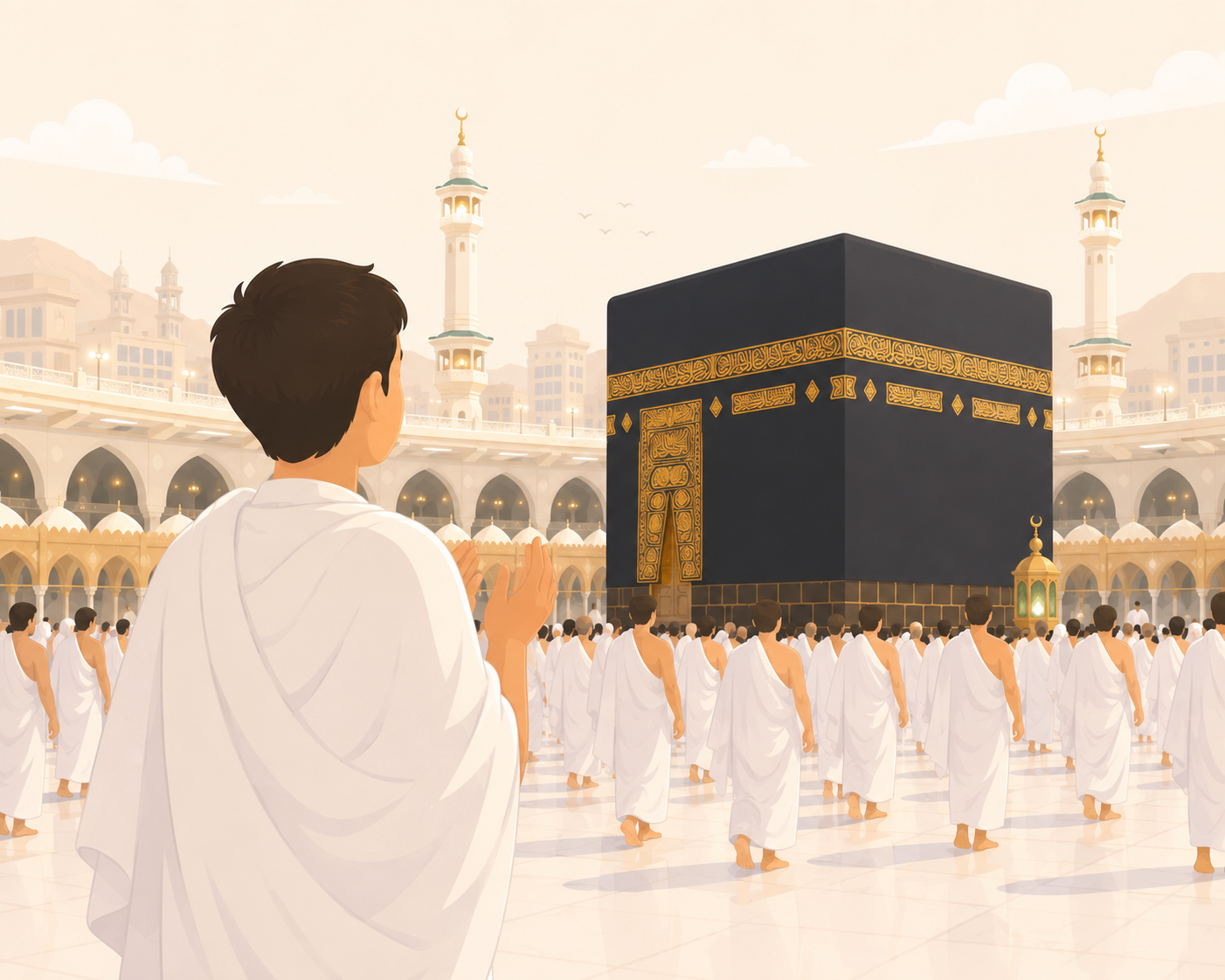
Before reaching the Miqat (the boundary around Makkah), every pilgrim enters the state of Ihram — a spiritual and physical state of sacred consecration. Men wear two white unsewn sheets; women wear modest clothing in any plain colour. The declaration of intention is made: Labbayk Allahumma labbayk, labbayka la sharika laka labbayk, innal-hamda wan-ni'mata laka wal-mulk, la sharika lak — "Here I am, O Allah, here I am. You have no partner. Here I am. Verily all praise, blessing, and sovereignty belong to You. You have no partner."
In Ihram, certain actions become prohibited: cutting hair or nails, using perfume, engaging in marital relations, harming animals or plants.
2. Tawaf — Circling the Kaaba
Upon arriving at Masjid al-Haram, the pilgrim performs Tawaf — walking seven times counter-clockwise around the Kaaba. The Kaaba is the cube-shaped structure at the centre of the Grand Mosque — the first house of worship built for Allah, constructed by Ibrahim and Ismail alayhimas-salaam. Tawaf is accompanied by du'a and dhikr.
3. Sa'i — Walking Between Safa and Marwa
After Tawaf, the pilgrim walks seven times between the hills of Safa and Marwa — commemorating the desperate search for water by Hajar (Hagar) when she was left in the desert with her infant son Ismail. This walk of faith — a mother's trust in Allah when all seemed hopeless — led to the miracle of Zamzam water, which still flows in Makkah today.
4. Wuquf at Arafat — The Standing
The 9th of Dhul Hijjah is the Day of Arafat — the most important day of Hajj. The Prophet ﷺ said: "Hajj is Arafat." (An-Nasa'i). Pilgrims spend the afternoon on the plain of Arafat, in prayer and supplication, calling upon Allah from midday until sunset. This is widely considered the most powerful act of du'a in a Muslim's life.
5. Muzdalifah, Mina, and Rami al-Jamarat
After Arafat, pilgrims travel to Muzdalifah for the night, then to Mina — where they perform the symbolic stoning of the pillars (Rami al-Jamarat), commemorating Ibrahim's rejection of Shaytan's temptations. This is followed by the sacrifice (Udhiyah/Qurbani) on Eid al-Adha, shaving the head (for men) or cutting the hair (for women), and returning to Makkah for a final Tawaf.
How to Prepare for Hajj
- Learn the rituals thoroughly — do not go to Hajj without understanding what you are doing and why. Study Hajj properly beforehand from a qualified scholar.
- Physical preparation — Hajj involves extraordinary amounts of walking. Build your stamina in the months before. Comfortable, broken-in footwear is essential.
- Emotional and spiritual preparation — make sincere Tawbah before going, reconcile with anyone you have wronged, return any trusts or debts. Go with a pure heart.
- Practical preparation — visas, vaccinations (meningitis vaccination is mandatory for Saudi entry), travel insurance, and UK banking access from abroad.
Preparing Your Children to Understand Hajj
Even if your child is too young to perform Hajj, Dhul Hijjah is the perfect time to teach them about this great pillar of Islam. The story of Ibrahim, Hajar, and Ismail is one of the most powerful stories in Islamic history — filled with tawakkul (trust in Allah), sacrifice, and divine mercy.
- Read the story of Ibrahim and Ismail together around Eid al-Adha
- Watch age-appropriate Hajj video tours so children can visualise the sacred sites
- If performing Qurbani (sacrifice), involve children in understanding its meaning
- Encourage children to make du'a on the Day of Arafat — this is the greatest day of du'a, whether or not you are in Makkah
Frequently Asked Questions
No — Hajj is obligatory only once in a lifetime. The Prophet ﷺ confirmed this explicitly when asked: "Hajj is once, and whoever does more than once, it is voluntary." (Abu Dawud). Additional Hajj journeys are Nafl (supererogatory) and highly rewarded, but not required.
Umrah is a shorter pilgrimage to Makkah that can be performed at any time of year. It is Sunnah Mu'akkadah (a confirmed Sunnah, highly recommended) but not obligatory. It consists of Ihram, Tawaf, and Sa'i, but does not include the standing at Arafat or the days at Mina. Hajj is the full, obligatory pilgrimage performed during Dhul Hijjah and includes all the major rites.
Yes — if a Muslim dies without having performed the obligatory Hajj and they were financially and physically able to do so, their family may perform Hajj on their behalf (Hajj al-Badal). The Prophet ﷺ explicitly approved this when asked. Ensure you have performed your own obligatory Hajj first.
A good Islamic Studies curriculum covers Hajj systematically — the story of Ibrahim, the five pillars, the rituals and their significance. At Moddaker Academy, our Islamic Studies sessions for children include dedicated Hajj and pillar education that gives children a genuine understanding of this great act of worship long before they are obligated to perform it.

Start Your Quran Journey with a Free Trial Lesson
Join hundreds of Muslim families across the UK learning with certified Al-Azhar scholars — one-on-one, online, at your pace.